Product Description
1.Highlighted Key points
Ground level enhancements (GLEs) of cosmic radiation are short-term manifestations of solar energetic particles arriving at Earth, potentially causing damage to electronic devices onboard the satellite platforms and increasing the radiation dose on human flights. The "GLE Alert ++" system produces a two-hour general GLE Alert graph every minute showing the occurrence or not of a GLE event. This system is based on real-time data from a network of Neutron Monitors. It generates automatically a summary of the status of the above stations. Graphs for each neutron monitor station participating to the above network, are also presented. The user can access the latest status of the service at , where the following values are available in csv format:
TIMESTAMP; STATIONS IN ALERT MODE(NUMBER); STATIONS IN ALERT MODE(NAMES); ALERT STATUS
2.Station Status
The physical concept as well as the applied algorithm are extensively described in Mavromichalaki et al. (2010), Souvatzoglou et al. (2014) and Mavromichalaki et al. (2018). Briefly describing the algorithm, it should be pointed out that it runs independently for each neutron monitor station participating in the network and produces its Alert status resulting from its cosmic ray measurements. Four alert levels (Alert level 0, 1, 2, and 3) are foreseen and calculated for each neutron monitor station. These alert levels are defined according to the time that the measurements exceed its moving average threshold (Souvatzoglou et al., 2014). In case three stations reach an alert mode in the same timeframe, then a general GLE Alert is produced. In this case, e-mails are sent to subscribed users.
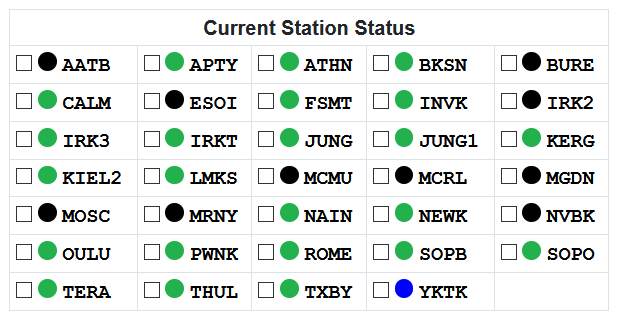 By clicking on the checkbox, the corresponding station plots are appeared.
By clicking on the checkbox, the corresponding station plots are appeared.
3.Station Summary
A station summary is automatically generated for all network stations according to their Alert level status. They are distinguished as:
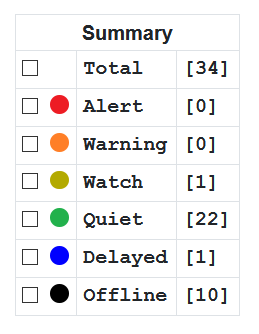 By clicking on the checkbox, the corresponding station plots are produced.
Some examples of the status of the stations are given below:
By clicking on the checkbox, the corresponding station plots are produced.
Some examples of the status of the stations are given below:
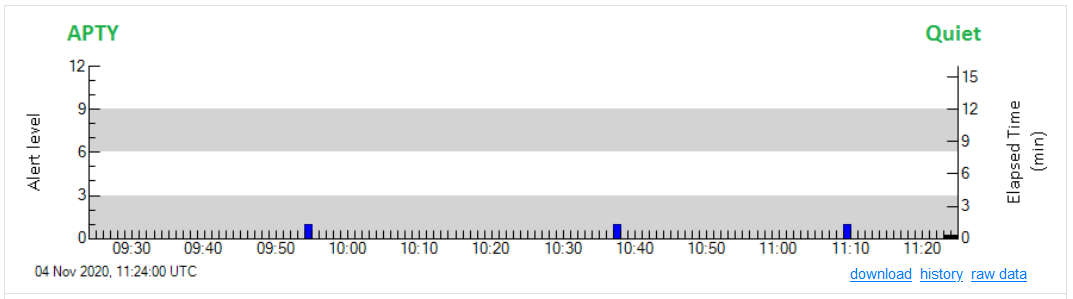
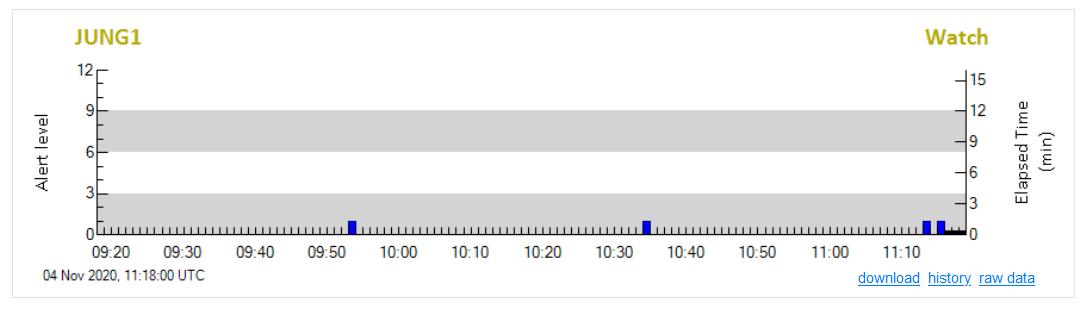

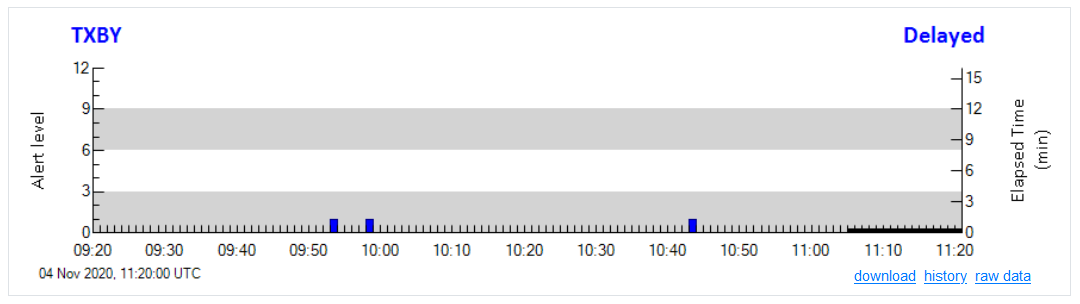 Below each station alert graph, three available links are placed: download, history and raw data. More specifically:
- Quiet for station alert level 0 (green color)
- Watch for station alert level 1 (yellow color)
- Warning for station alert level 2 (orange color)
- Alert for station alert level 3 (red color)
- Delayed for stations that are nearly real time and send usable minutely data in a predetermined time window (Souvatzoglou et al., 2014)
- Offline for stations that do not send at least one measurement in the above time window
By clicking on the checkbox, the corresponding station plots are produced.
Some examples of the status of the stations are given below:
Below each station alert graph, three available links are placed: download, history and raw data. More specifically:
- Download: the current station alert graph can be downloaded.
- History: a file with historical station alerts is presented. In this file for every station alert, the following values are available in csv format:
- SERVER TIMESTAMP; STATION TIMESTAMP; ALERT LEVEL; ALERT TIMER
- Raw Data: a file with the data results of the algorithm for the last hour for the corresponding station is presented. The following values are available in csv format:
- SERVER TIMESTAMP; STATION TIMESTAMP; ALERT LEVEL; ALERT TIMER; ALERT STATUS
4.General GLE Alert Graph
Based on the above summary, a general alert status is indicated on the homepage.

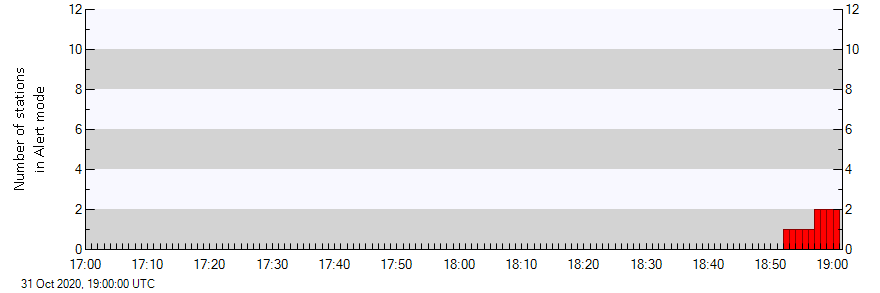 The current date, the time in UTC and the corresponding Alert status are presented on top of the general GLE Alert graph. A graphical representation of the general GLE Alert status is created every minute. This graph has 2-hours duration, so the user could browse back in steps of 2 hours. The time of the GLE Αlert server is given in UTC on the X-axis, while on the Y-axis the number of stations in alert mode and the duration of the alert of each station are presented.
Below the General GLE Alert graph, three available links are given: download, history and raw data. More specifically:
The current date, the time in UTC and the corresponding Alert status are presented on top of the general GLE Alert graph. A graphical representation of the general GLE Alert status is created every minute. This graph has 2-hours duration, so the user could browse back in steps of 2 hours. The time of the GLE Αlert server is given in UTC on the X-axis, while on the Y-axis the number of stations in alert mode and the duration of the alert of each station are presented.
Below the General GLE Alert graph, three available links are given: download, history and raw data. More specifically:
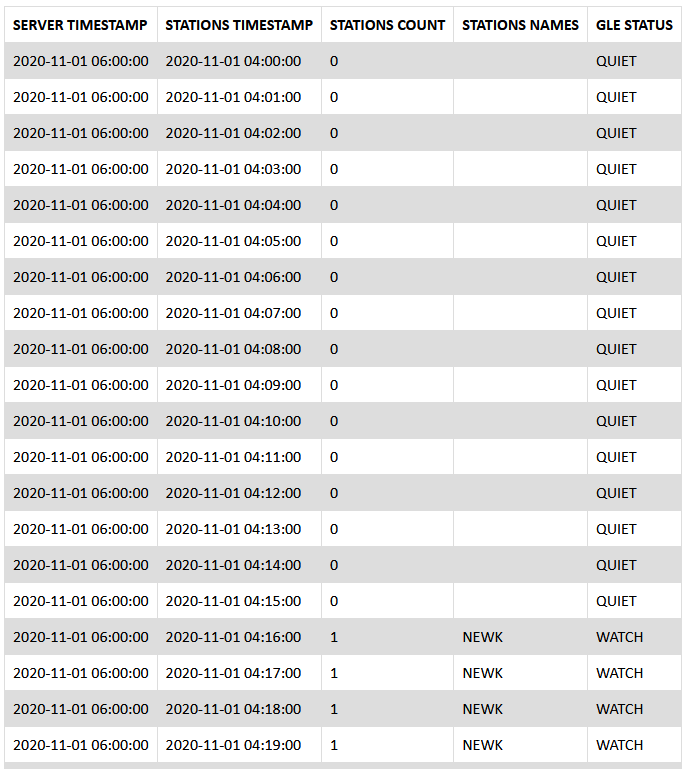
The current date, the time in UTC and the corresponding Alert status are presented on top of the general GLE Alert graph. A graphical representation of the general GLE Alert status is created every minute. This graph has 2-hours duration, so the user could browse back in steps of 2 hours. The time of the GLE Αlert server is given in UTC on the X-axis, while on the Y-axis the number of stations in alert mode and the duration of the alert of each station are presented.
Below the General GLE Alert graph, three available links are given: download, history and raw data. More specifically:
- Download: the current General GLE graph can be downloaded.
- History: a file with historical General GLE Alerts is presented. In this file for every general alert, the following values are available in csv format:
- SERVER TIME STAMPS; STATION TIMESTAMP; STATIONS COUNT; STATION NAMES
- Raw Data: is a file with the data results of the algorithm for the last two hours for the general GLE Alert status is presented. The following values are available in csv format:
- SERVER TIME STAMPS; STATION TIMESTAMP; STATIONS COUNT; STATION NAMES; GLE STATUS
References
- Mavromichalaki H., Souvatzoglou G., Sarlanis C., Mariatos G., Papaioannou A. for the NMDB team (2010), "Implementation of the Ground Level Enhancement Alert Software at NMDB database", New Astron. 15(8), 744-748, DOI: 10.1016/j.newast.2010.05.009
- Souvatzoglou G., Papaioannou A., Mavromichalaki H., Dimitroulakos J., Sarlanis C. (2014), "Optimizing the real-time ground level enhancement alert system based on neutron monitor measurements: introducing GLE Alert Plus", Space Weather 12, 633–649, DOI:10.1002/2014SW001102
- Mavromichalaki H., Gerontidou M., Paschalis P., Paouris E., Tezari A., Sgouropoulos C., Crosby N., Dierckxsens M. (2018), "Real Time Detection of the Ground Level Enhancement on 10 September 2017 by A.Ne.Mo.S.: System Report", Space Weather 16(11), 1797-1805, DOI: 10.1029/2018SW001992